If you’re thinking about introducing your 4-year-old to Brazilian Jiu-Jitsu, you may be wondering:
Is four too young? Will my child actually pay attention? Should they be learning techniques already? What if they’re shy or don’t want to participate?
After years of teaching young children, my answer is that four is an excellent age to begin Brazilian Jiu-Jitsu—but you have to approach training differently than you would with an older child.
At four years old, the goal isn’t to create a little black belt overnight.
The goal is to help your child become comfortable on the mat, learn to follow directions, develop movement skills, and most importantly, have fun.
If you get those things right, the technical development can come later.
Is 4 Years Old Too Young for Jiu-Jitsu?
I don’t think so. In fact, I consider four an ideal age to introduce a child to Brazilian Jiu-Jitsu.
At this age, children are beginning to understand directions, become more aware of their bodies, and learn how to control their movements.
As they get older, they can gradually understand more of the intricacies of Brazilian Jiu-Jitsu and become increasingly technical.
So if your goal is for your child to potentially train Jiu-Jitsu for many years, starting around four gives them an opportunity to build that foundation early.
But that doesn’t mean you should expect a four-year-old to train like a 10-year-old.
That’s where the right instruction matters.
What Should a 4-Year-Old Learn First?
For a young child, I would prioritize three things:
Getting comfortable on the mat.
Following the instructor’s directions.
Having fun.
If your child can accomplish those three things, they’re already learning.
You don’t need to worry about whether they can perform every technique perfectly.
You want them to become comfortable moving around the mat, listening to their instructor, interacting with other children, and enjoying the experience.
That creates the foundation for everything that comes later.
Don’t Pressure Your Child to “Pay Attention”
One of the biggest mistakes I’ve seen parents make is putting too much pressure on their child to perform.
A parent may see their 4-year-old looking around and say:
“Pay attention!”
“Listen to your instructor!”
“Do the move!”
But sometimes the best thing a parent can do is trust the instructor and the process.
Young children develop at different rates.
If you keep bringing them to class, allow them to become comfortable, and let the instructor work with them, their ability to focus and follow directions will develop naturally.
You don’t need to turn Jiu-Jitsu into another source of pressure.
What Does Jiu-Jitsu Look Like for a 4-Year-Old?
A good class for a four-year-old should be simple, active, and fun.
Rather than expecting a young child to stand still while someone gives them a complicated technical explanation, instructors can incorporate Jiu-Jitsu movements into drills and games.
The child is learning while they’re moving and having fun.
At this age, simplicity is extremely important.
You don’t need to teach complicated techniques.
You need to introduce basic movements and positions in ways that a young child can understand.
Drilling Should Come Before Rolling
I don’t think a four-year-old needs to immediately jump into hard sparring.
The first step should be learning how to perform movements with a cooperative partner.
As the child begins understanding the movements and, more importantly, the positions, they can gradually begin training more actively.
For example, I want a young student to become familiar with positions such as:
- Mount
- Side control
- Back control with hooks
- Guard
Once they understand these basic positions, they’re in a much better place to begin controlled rolling.
Understanding comes before intensity.
A young child doesn’t need to be thrown into the deep end to learn Jiu-Jitsu.
Let Your Child Play Jiu-Jitsu at Home
Parents can actually reinforce what their child is learning at home—but there’s an important rule:
Keep it playful.
Don’t turn practice into homework.
You don’t need to demand perfect technique from your four-year-old.
Instead, you can simply play with positions.
For example, you might let your child climb into mount on you, practice having their legs around you from the back, or experiment with having their feet on your hips while playing guard.
You’re essentially letting them play the positions.
That’s a much better approach for a young child than repeatedly saying, “Do the technique correctly.”
What If My 4-Year-Old Is Shy?
Some children walk onto the mat immediately.
Others don’t.
And that’s okay.
I’ve seen situations where the real problem wasn’t that the child didn’t like Jiu-Jitsu. They simply weren’t comfortable with the instructor yet.
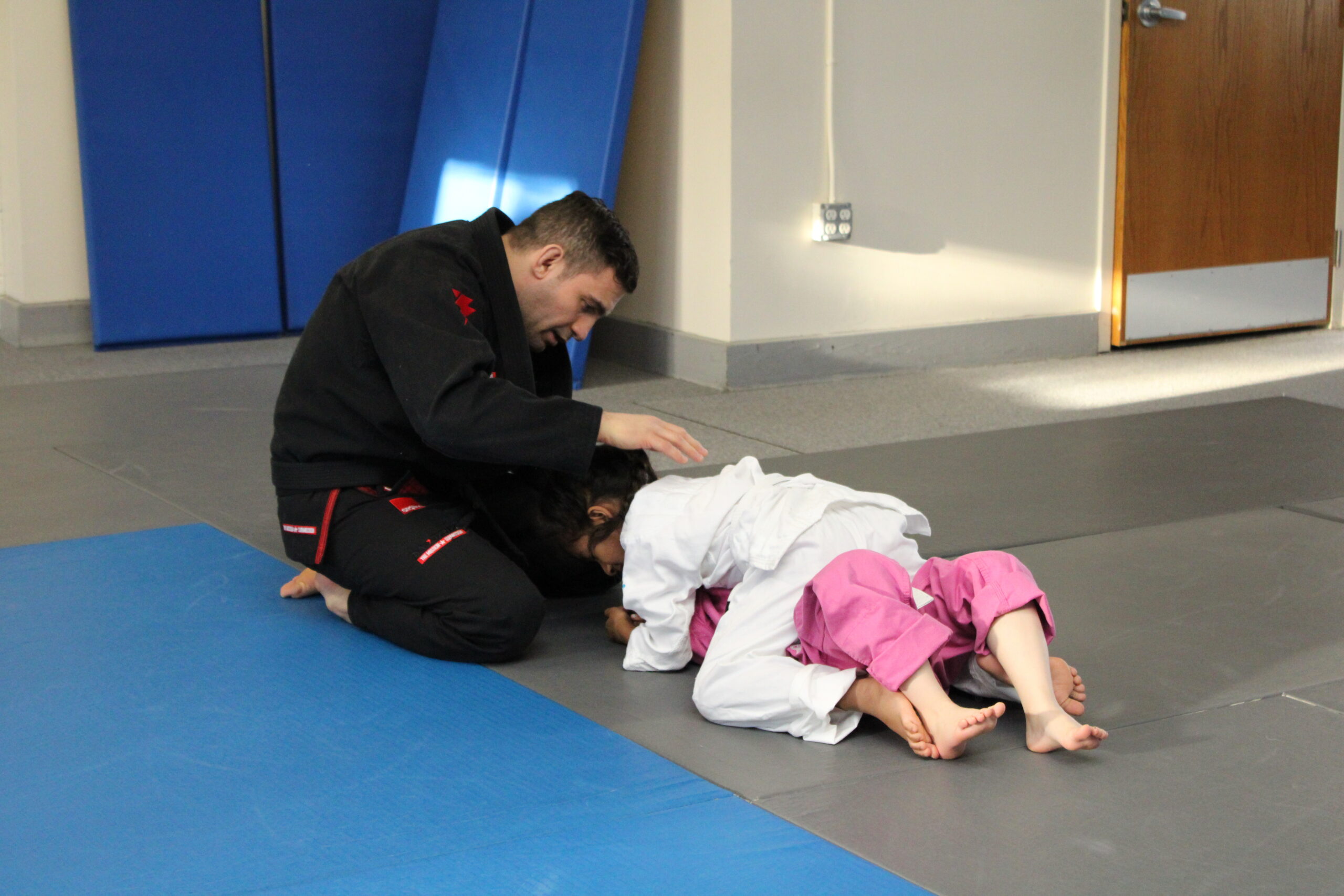
If that’s the case, a private lesson can be extremely helpful.
Even one private session can give a shy child an opportunity to get comfortable with the instructor without the pressure of a group class.
Once that relationship develops, Mom and Dad can sit on the side while the instructor takes over.
The goal isn’t to force the child onto the mat.
The goal is to help them feel safe enough that they want to step onto it.
What Should Parents Look for in a Jiu-Jitsu School?
If you’re looking for Brazilian Jiu-Jitsu for a 4-year-old, don’t just look at whether the school offers a children’s class.
Look at who is teaching it and how they teach it.
A good instructor should know how to:
- Keep instructions simple
- Keep young children safe
- Make learning fun
- Keep children engaged
- Teach age-appropriate movements
- Understand how young children develop
Teaching adults and teaching four-year-olds are completely different skills.
A great instructor knows the martial art and knows how to communicate it to a child.
What Can a 4-Year-Old Gain From Jiu-Jitsu?
The benefits go well beyond learning how to grapple.
Young children develop greater awareness of their bodies and learn movements they may not encounter in other activities.
They can develop:
- Coordination
- Balance
- Body awareness
- Physical fitness
- Social skills
- Confidence
- Listening skills
I’ve also seen children take the physical skills and coordination they develop through Jiu-Jitsu and carry them into other sports.
They’re not just learning an activity.
They’re learning how to use their bodies.
Don’t Measure Success by Technique
This is probably the most important thing I would tell a parent.
Don’t expect too much from a four-year-old.
Your child doesn’t need to perform every technique perfectly.
They don’t need to win every roll.
They don’t need to advance faster than another child.
At this age, success is much simpler.
Are they becoming comfortable on the mat?
Are they learning to follow directions?
Are they having fun?
Do they want to come back?
If the answer is yes, they’re on the right track.
The child who loves coming to class has something far more valuable than perfect technique at age four: a positive relationship with Jiu-Jitsu.
And that can become the foundation for years of learning.
Start With Fun, and Let the Skills Come
If you want your 4-year-old to develop a lifelong relationship with Brazilian Jiu-Jitsu, don’t make the mistake of trying to make them a serious martial artist too quickly.
Let them be four.
Let them play.
Let them make mistakes.
Let them learn at their own pace.
Give them an instructor who knows how to keep things simple, safe, and fun.
The most important thing is that your child wants to keep showing up on the mat.
If they enjoy Jiu-Jitsu, the learning will come.
And over the years, those simple movements, positions, and lessons can grow into something much more sophisticated.
That’s how you introduce a four-year-old to Jiu-Jitsu—not by demanding perfection, but by helping them fall in love with being on the mat.